

Not All Homes Are Financed the Same Way: What Sellers Should Know Before Listing
Most homeowners don't think much about how their home was originally built.
They know it is their home, they know what they paid for it, and they know what improvements they've made over the years. But when it comes time to sell, the way a home was constructed can sometimes affect how a buyer is able to finance it.
That matters to sellers because financing can affect the pool of buyers who are able to purchase the property.
This is particularly important when a property is a manufactured home, modular home, or another type of factory-built housing. These homes are not all treated the same way for financing purposes, and the details of the property can matter.
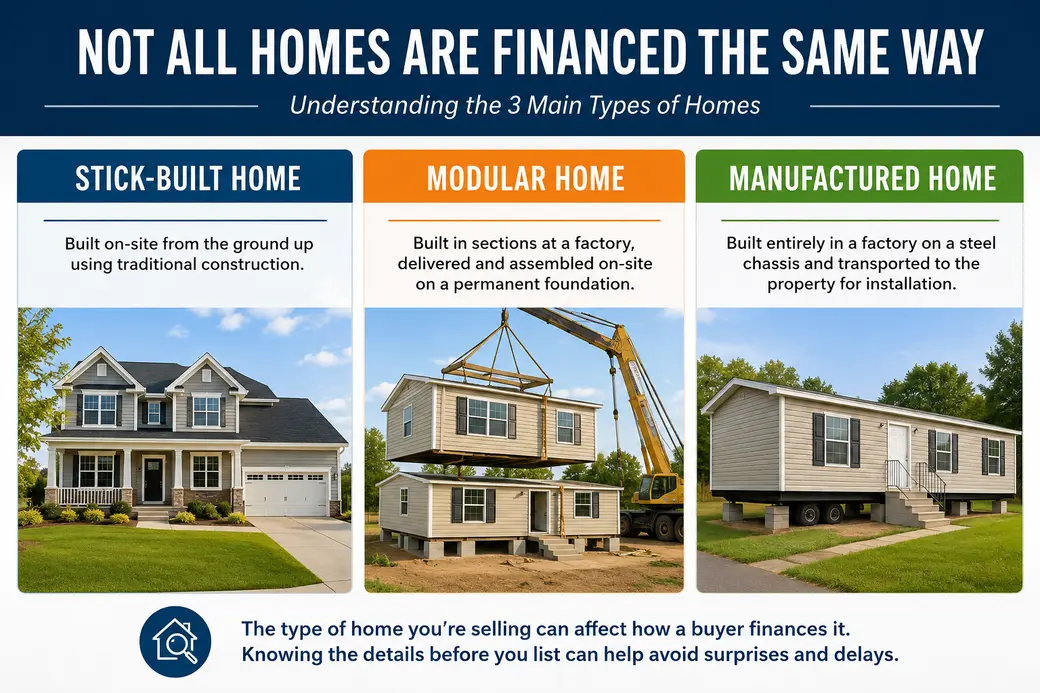
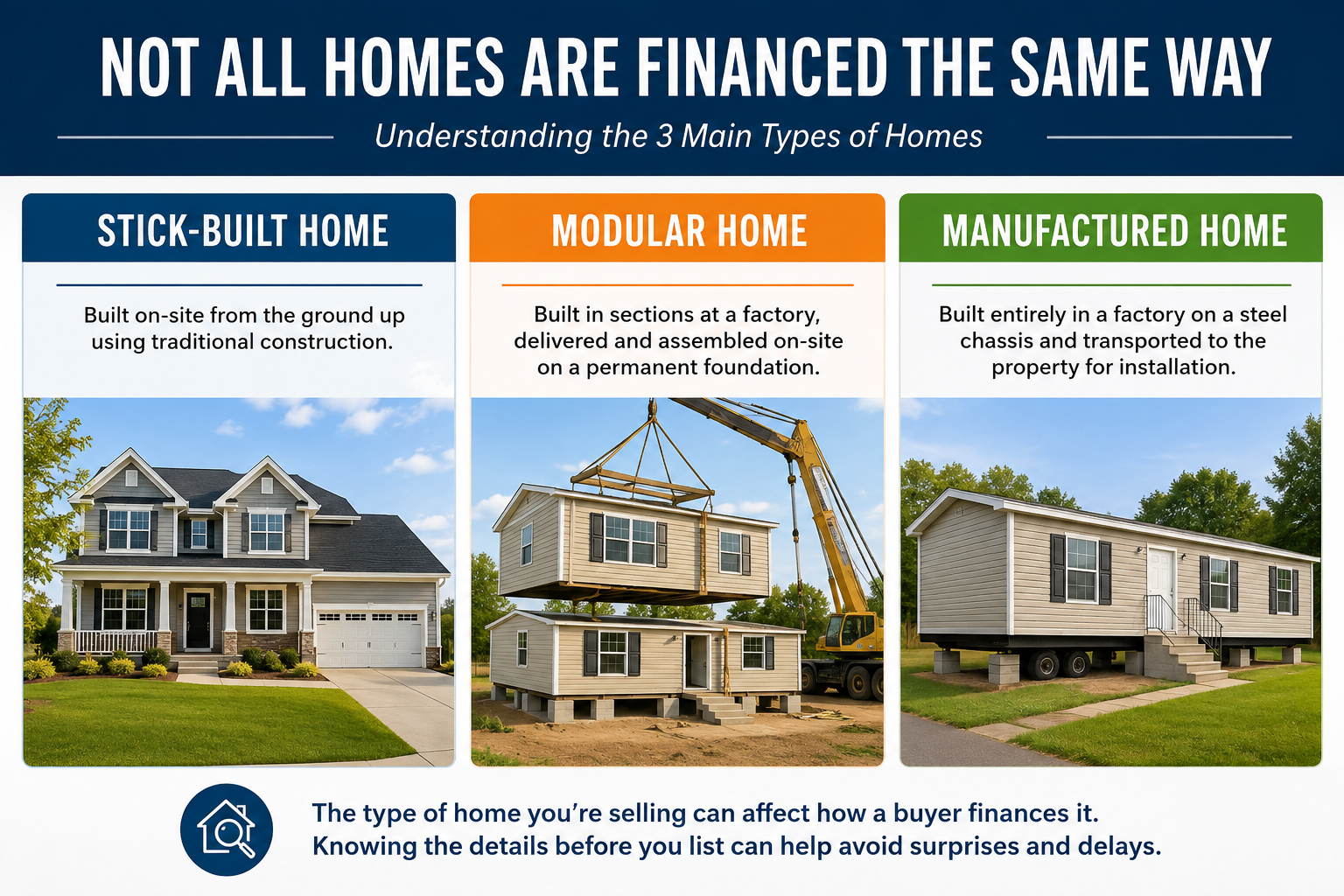
Stick-Built, Modular and Manufactured: What's the Difference?
A traditional stick-built home is constructed on the property using conventional building methods. It is generally financed as a standard residential property.
A modular home is built in sections at a factory and then transported to the property and assembled on-site. Modular homes are generally built to applicable state and local building codes and, when they meet the requirements for real property, can be financed similarly to traditional site-built homes.
Manufactured homes are different. They are constructed in a factory on a permanent chassis and are subject to federal manufactured housing standards. For conventional financing, lenders may need to verify additional details, including how the home is attached to the land and how it is legally classified.
The distinction isn't always obvious just by looking at a house.
Two homes can look very similar from the outside but have different construction histories, documentation and financing considerations.
Why Should a Seller Care?
Because these details can become important after you have accepted an offer.
A buyer may be fully qualified financially, but their lender still has to determine whether the property meets the requirements for the particular loan being used.
Depending on the type of property, questions may involve:
-
How the home was constructed
-
Whether it is permanently attached to a foundation
-
Whether the home and land are legally classified as real property
-
Whether required documentation is available
-
Whether the property meets applicable building or installation requirements
-
Whether the lender needs additional information for underwriting or appraisal
These aren't necessarily problems.
The problem is discovering them late.
If a lender requests documentation after escrow is already underway, or determines that additional requirements need to be met, the seller may suddenly be dealing with a new issue that can affect the timing of the transaction.
The Best Time to Find Out Is Before You List
This is one of the reasons I believe preparation matters so much when selling a home.
If there is something unusual about a property, I'd rather identify it before we put the home on the market than after we have an accepted offer and a buyer is already working through the loan process.
That gives the seller time to gather documents, clarify the property's status and, when necessary, consult with the appropriate lender, title professional, engineer or other specialist.
It also allows us to understand the potential buyer pool before we establish a marketing and pricing strategy.
The goal isn't to assume there will be a financing problem.
The goal is to avoid being surprised by one.
What About Manufactured Homes?
Manufactured homes can be financed, but the requirements can be different from those for a traditional site-built home.
For example, conventional lenders may have requirements concerning the home's permanent foundation, its classification as real property and documentation such as the HUD Data Plate and Certification Label.
The specific requirements depend on the property and the loan program, so sellers should not assume that every manufactured home will have the same financing options.
This is an area where having the right professionals involved early can make a difference.
Amy's Perspective
When I meet with a seller, I'm not only thinking about how to market the home. I'm also looking at the things that could affect the transaction once we find a buyer.
If a property has a construction history, title situation or other characteristic that could raise questions for a lender, I want to know about it before we are under contract.
That doesn't mean I try to make lending decisions or give advice that belongs to a lender, title company, engineer or other specialist. My role is to recognize when something may require additional attention and make sure the right questions are being asked early.
For a seller, that can make a meaningful difference.
The goal is not to eliminate every possible complication. Real estate transactions rarely go exactly according to plan. The goal is to identify potential issues while there is still time to address them, rather than discovering them when a closing date is approaching.
The Bottom Line
Not every home is built the same way, and not every home is financed the same way.
If you own a manufactured, modular or other factory-built home, that doesn't automatically mean selling it will be difficult or that financing will be limited.
It does mean that the property's construction and documentation are worth understanding before you put the home on the market.
A good listing professional should be thinking beyond the marketing and the offer. The objective is to prepare the property, anticipate potential issues and help the transaction move as smoothly as possible from listing to closing.
If you're considering selling and aren't sure whether the construction or history of your home could affect the sale, that's something worth discussing before you go on the market.
Amy Saflar
Coldwell Banker West
DRE 01238780
Source: Fannie Mae Selling Guide and Freddie Mac Single-Family Seller/Servicer Guide, current guidance on manufactured and modular housing.
Categories
Recent Posts


GET MORE INFORMATION
