

California Housing Affordability Slipped in the Second Quarter: Here’s What Homeowners Should Know.

California Housing Affordability Slipped in the Second Quarter: Here’s What Homeowners Should Know.
California housing affordability improved noticeably at the beginning of 2026, reaching its highest level in four years. But that improvement did not last.
According to the California Association of REALTORS® (C.A.R.), housing affordability declined in the second quarter of 2026 as mortgage rates increased and home prices moved higher.
That may sound like a statistic that primarily affects buyers, but it is important for homeowners and sellers to understand, too.
What Changed?
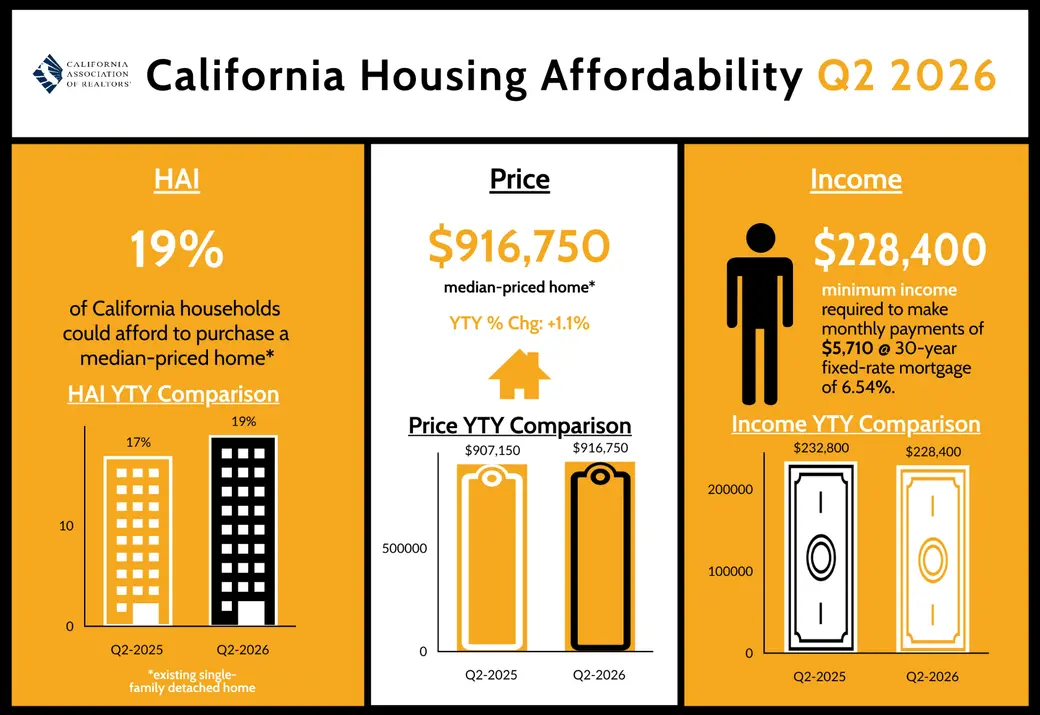
In the second quarter, 19% of California households could afford to purchase the state's median-priced home, which was $916,750.
That was down from 22% in the first quarter of 2026. However, affordability was still better than it was a year earlier, when only 17% of households could afford the median-priced home.
So, while affordability has become more difficult again, the picture is not simply getting worse. Compared with a year ago, there has been some improvement.
The change from the first quarter was largely the result of two things: higher mortgage rates and higher home prices.
The average interest rate used in C.A.R.'s calculation was 6.54% for a 30-year fixed-rate mortgage. At that rate, a buyer needed an annual income of approximately $228,400 to afford the typical California home.
The estimated monthly payment was about $5,710, including principal, interest, property taxes and insurance.
Source: California Association of REALTORS®, 2nd Quarter 2026 Housing Affordability Index.
Condos and Townhomes Are Somewhat More Affordable
The numbers look better for buyers considering a condo or townhome.
About 30% of California households could afford the median-priced condo or townhome, which was $670,000.
A buyer needed an annual income of approximately $166,800 to afford the estimated monthly payment of $4,170.
That difference illustrates an important point: affordability depends not only on mortgage rates, but also on the price of the property a buyer is considering.
Why Does This Matter to Homeowners?
It is easy to look at housing affordability statistics and assume they are primarily a buyer issue. They aren't.
Affordability directly affects the pool of potential buyers for a home.
When mortgage rates rise, a buyer's purchasing power can decrease even if the price of a home has not changed. A buyer who was comfortable with a certain monthly payment earlier in the year may have less purchasing power today because a larger portion of that payment is going toward interest.
That is one reason pricing a home appropriately matters so much in the current market.
A seller may look at what a neighboring home sold for and assume their property should be priced similarly. But buyers are making decisions based on today's financing costs—not the financing costs that were available when that previous sale occurred.
What Does This Mean for the San Diego Market?
California's statewide numbers don't tell the whole story, particularly in a market as diverse as San Diego County.
Local home prices, inventory, neighborhood demand, property type and buyer demographics all affect affordability. A home in La Mesa, for example, is competing for a different buyer pool than a luxury property in coastal San Diego.
That's why I believe statewide statistics are most useful as context, rather than as a direct indicator of what any particular San Diego home is worth.
Amy's Perspective
After nearly three decades of selling real estate in San Diego County, I've learned that market statistics are most useful when they are put into local context.
When I advise a seller on pricing, I don't look at one number or one report. I look at comparable sales, current competition, inventory, buyer activity and the type of buyer most likely to purchase the property. I also consider how today's mortgage rates affect what those buyers can comfortably afford each month.
That's particularly important right now. A home can be worth a certain amount based on recent sales, but if the price pushes the monthly payment beyond what many buyers can manage, it can affect the number of potential buyers willing to compete for it.
For homeowners considering a sale, the goal isn't simply to choose a price that sounds good. It's to understand where the property fits in today's market and how buyers are likely to respond to that price.
The Bigger Picture
The second-quarter numbers don't mean California's housing market has suddenly become unaffordable for everyone. In fact, affordability is still better than it was a year ago.
But the improvement we saw early in 2026 has moderated.
For buyers, that means monthly payments remain an important consideration. For sellers, it reinforces the importance of understanding today's buyer and pricing a property based on current market conditions—not simply on what homes sold for in the past.
Real estate is local. Statewide statistics provide useful perspective, but when you're making a decision about your own home, the most meaningful information is what is happening in your neighborhood and with properties similar to yours.
If you're thinking about selling and would like an objective look at your home's position in today's market, I'm happy to help you understand the numbers and what they mean for your particular property.
Source: California Association of REALTORS®, 2nd Quarter 2026 Housing Affordability Index.
Amy Saflar
Coldwell Banker West
DRE 01238780
Categories
Recent Posts


GET MORE INFORMATION
